SAE Vs. STD Comparison Thread
 01-27-2009, 09:54 AM
#1

 SAE Vs. STD Comparison Thread
 Guys recently we've had several people in our threads interested in corrections used here at TSP. Apparently some shops are using uncorrected numbers during the winter months to push up their dyno numbers.
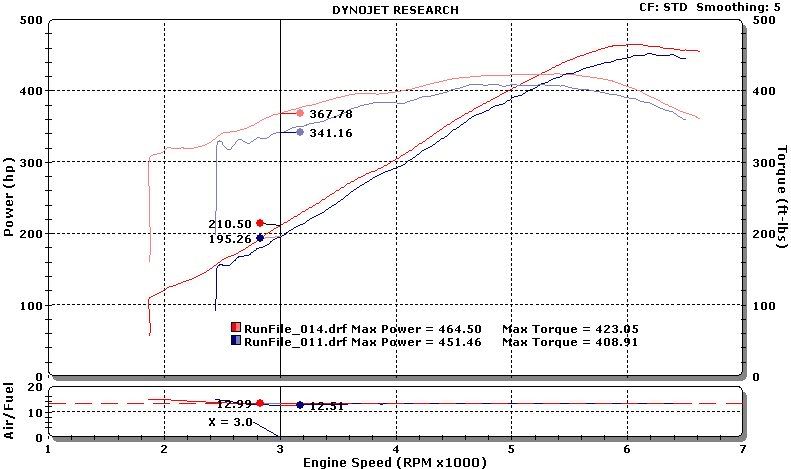
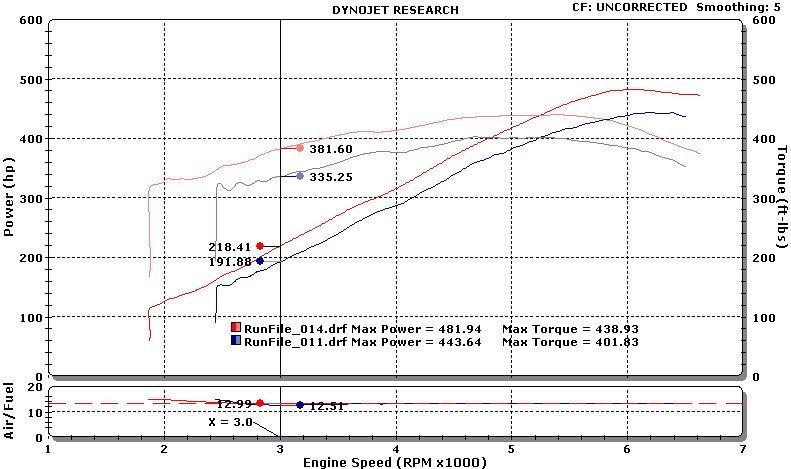
Apparently STD & SAE corrections can vary by large amounts depending on the conditions/altitude/etc.... As a result here's a sae vs std dyno sheet for you guys to inspect.
I think it would be good if we get other shops to post in here with how there sae & std numbers compare.


Apparently STD & SAE corrections can vary by large amounts depending on the conditions/altitude/etc.... As a result here's a sae vs std dyno sheet for you guys to inspect.
I think it would be good if we get other shops to post in here with how there sae & std numbers compare.
__________________
Jason
Co-Owner, Texas Speed & Performance, Ltd.
2005 Twin Turbo C6
404cid Stroker, 67mm Twins
994rwhp/902lb ft @ 22 psi (mustang dyno) www.Texas-Speed.com
Jason
Co-Owner, Texas Speed & Performance, Ltd.
2005 Twin Turbo C6
404cid Stroker, 67mm Twins
994rwhp/902lb ft @ 22 psi (mustang dyno) www.Texas-Speed.com
Last edited by Jason 98 TA; 01-27-2009 at 10:00 AM.


 01-27-2009, 10:24 AM
#3

Here's the correction factors:
SAE:
"SAE (Society of Automotive Engineers), USA. Power is corrected to reference conditions of 29.23 InHg (99 kPa) of dry air and 77 F (25°C). This SAE standard requires a correction for friction torque.
STD:
STD is Another power correction standard determined by the SAE. Power is corrected to reference conditions of 29.92 InHg (103.3 kPa) of dry air and 60 F (15.5°C). Because the reference conditions include higher pressure and cooler air than the SAE standard, these corrected power numbers will always be about 4 % higher than the SAE power numbers. Friction torque is handled in the same way as in the SAE standard."
Good comparison ed, that shows the difference between uncorrected and the correction factors.
SAE:
"SAE (Society of Automotive Engineers), USA. Power is corrected to reference conditions of 29.23 InHg (99 kPa) of dry air and 77 F (25°C). This SAE standard requires a correction for friction torque.
STD:
STD is Another power correction standard determined by the SAE. Power is corrected to reference conditions of 29.92 InHg (103.3 kPa) of dry air and 60 F (15.5°C). Because the reference conditions include higher pressure and cooler air than the SAE standard, these corrected power numbers will always be about 4 % higher than the SAE power numbers. Friction torque is handled in the same way as in the SAE standard."
Good comparison ed, that shows the difference between uncorrected and the correction factors.
Last edited by Kaltech Tuning; 01-27-2009 at 10:44 AM.

 01-27-2009, 11:46 AM
#6

Yes, most shops use it to "level out" the field and give some sort of consistency to these graphs across the board.
__________________

Largest Stocking Distributor of LS-x Engines / CHECK OUT OUR NEW WEBSITE!
COMP - FAST - PACESETTER - DIAMOND RACING - EAGLE SPECIALTY PRODUCTS - CALLIES - COMETIC GASKETS
RAM CLUTCHES - MOSER ENGINEERING - KOOK'S HEADERS - ARP - GM BOLTS AND GASKETS - MSD - NGK
POWERBOND - ASP - AND MORE!
Largest Stocking Distributor of LS-x Engines / CHECK OUT OUR NEW WEBSITE!
COMP - FAST - PACESETTER - DIAMOND RACING - EAGLE SPECIALTY PRODUCTS - CALLIES - COMETIC GASKETS
RAM CLUTCHES - MOSER ENGINEERING - KOOK'S HEADERS - ARP - GM BOLTS AND GASKETS - MSD - NGK
POWERBOND - ASP - AND MORE!



Trending Topics
01-27-2009, 01:31 PM
#8

LOL..Who cares what a shop uses when putting a car on the rollers. Just be consistant when posting graphs. If it's my car, use STD, SAE, or uncorrected. It doesn't matter. The dyno is just a tool used for tuning, not measuring the size of your dick.

 ...lol
  01-27-2009, 03:43 PM
#11
Your statement is correct. However I think the point trying to be made here is that you can't post corrected numbers (sae or std) then post uncorrected numbers when the weather is beneficial for hp and try to make an a to b comparison of parts. Just the same you can't have an uncorrected example in the middle of the summer being compared to an uncorrected example in the middle of winter. Both scenarios use weather to your advantage to advertise the parts you want to look better. A 30 degree drop in air temp. will give you about an extra 5% hp bump, that's 20 hp on a 400hp setup. The correction factors allow you to take weather out of the equation and provide more apples to apples comparisons.
01-27-2009, 04:38 PM
#12

I prefer uncorrected numbers for my personal race car, much like uncorrected time slips. But for internet comparison, I use the SAE numbers. By the way, STD is an SAE correction factor, previous to the "SAE" standard. I forget their respect SAE Spec numbers though. If you are going to post (un)corrected numbers, keep it consistant. 
01-27-2009, 04:45 PM
#13
I prefer uncorrected numbers for my personal race car, much like uncorrected time slips. But for internet comparison, I use the SAE numbers. By the way, STD is an SAE correction factor, previous to the "SAE" standard. I forget their respect SAE Spec numbers though. If you are going to post (un)corrected numbers, keep it consistant.
01-27-2009, 05:35 PM
#14
TECH Enthusiast
iTrader: (1)
Join Date: Dec 2005
Location: Denver International Airport, Colorado USA
Posts: 549
Likes: 0
Received 0 Likes
on
0 Posts
Jason, I prefer "SAE" correction factors, but I agree the equations that use temperature, humidity, and altitude are far from perfect.
Since 95% of shops are located at elevation of 1000' or below, SAE works almost flawlessly.
Your elevation at Lubbock (~3200ft) on some days can put you at a disadvantage when computing a correction factor, depending on the air density on that particular day. It is even more difficult getting consistent dyno numbers here in Denver (5280').
My point is SAE is preferred, but not perfect. Errors from uncorrected to STD or SAE become greater as dyno elevation increases.
My suggestion is to utilize SAE, with dyno elevation prominently displayed. Perhaps a standard 'disclaimer' that elevation errors range on average ~1-3% greater than at sea level.
Hope this is what you were looking for.
..WeathermanShawn..
Since 95% of shops are located at elevation of 1000' or below, SAE works almost flawlessly.
Your elevation at Lubbock (~3200ft) on some days can put you at a disadvantage when computing a correction factor, depending on the air density on that particular day. It is even more difficult getting consistent dyno numbers here in Denver (5280').
My point is SAE is preferred, but not perfect. Errors from uncorrected to STD or SAE become greater as dyno elevation increases.
My suggestion is to utilize SAE, with dyno elevation prominently displayed. Perhaps a standard 'disclaimer' that elevation errors range on average ~1-3% greater than at sea level.
Hope this is what you were looking for.
..WeathermanShawn..
01-27-2009, 06:23 PM
#15
I don't think it's that simple. There are far too many variables at the track to find consistent results from a given setup. The dyno simplifies this process as all you have to do is spin the rollers. The use of correction factors create an even more level playing field when it comes to comparing setups and finding consistency. If somoeone went to the track in 2000 DA then changed their setup and went back to the track in -2000 DA, then said they gained from the changes how would you know if the gains were from the changes or DA? You'd have to use some sort of calculation to figure out the gains from DA then look at it apples to apples. The dyno with correction factors allows you to determine relative power between setups and that's all. It takes more that just power to get down the track right? That's the point here, using correction factors to keep things apples to apples and eliminate as many variables as possible.



 01-27-2009, 07:08 PM
#17
LSxGuy widda 9sec Mustang
iTrader: (12)

Join Date: Nov 2001
Location: Texas and Qatar
Posts: 3,043
Likes: 0
Received 0 Likes
on
0 Posts

Just to clarify something. If TSP or any dyno at a high(er) elevation uses uncorrected numbers the dyno numbers would be a ton less than SAE corrected numbers; no matter the time of year. That is also a reason we never race locally with an N/A car; all cars are about .6 slower in ET compared to ~1000 ft DA, in fact the best DA I've ever raced in locally was +2900DA.
01-27-2009, 07:24 PM
#18
12 Second Club
iTrader: (4)

Join Date: Jan 2005
Location: Texas
Posts: 1,200
Likes: 0
Received 0 Likes
on
0 Posts

YES! I dont like dyno races either. And why I like the track near seguin than the ones here in west texas. I do like that Penwell is reopening, its better than nothing, but well yall know. Tune it and Ill take it to the track to show the results.