




Why not use variable nozzle turbos on rear mount STS kits?

Thread Starter
Registered User
Joined: Sep 2008
Posts: 29
Likes: 0
 Why not use variable nozzle turbos on rear mount STS kits?
 If rear mounting turbos results in lower turbo temps wouldn't it be a good idea to take advantage of that and use variable nozzle turbos?
With variable nozzle turbos a person could use larger A/R housing turbos while still theorectically retaining the responsiveness of a turbo with a smaller A/R housing.
With variable nozzle turbos a person could use larger A/R housing turbos while still theorectically retaining the responsiveness of a turbo with a smaller A/R housing.

9 Second Club
Joined: Nov 2003
Posts: 13,616
Likes: 185
From: Norn Iron
good thinking...but Im not sure there are large enough units available, and VNT would cost a fair bit more.
Boost control is a little more complex too, and is usually performed by vacuum controlled by the ecu.
Instead of simple pressure control like normal setups.
Boost control is a little more complex too, and is usually performed by vacuum controlled by the ecu.
Instead of simple pressure control like normal setups.
Thread Starter
Registered User
Joined: Sep 2008
Posts: 29
Likes: 0
Is this the price of a diesel spec turbo or the price for one of those gasoline spec Porsche 997 turbos?
I do agree the Porsche 997 turbos would be too small although they are apparently heat treated to take the temperatures of a front mount location.

Launching!
Joined: May 2004
Posts: 266
Likes: 0
vtn turbos only go so big from what i found if some one could find a bigger one im sure it would be doable
plus im sure cost would be alot higher than a comparable turbo even DBB
which leads to reason why not use a same/or bigger DBB turbo with more effective heat management ...read header and pipes wrapped all the way to a jacketed turbo and coatings in conjuction
plus fabrication with thicker walled pipes would be something to look at
plus im sure cost would be alot higher than a comparable turbo even DBB
which leads to reason why not use a same/or bigger DBB turbo with more effective heat management ...read header and pipes wrapped all the way to a jacketed turbo and coatings in conjuction
plus fabrication with thicker walled pipes would be something to look at
Trending Topics
LS1 Tech Stories
The Best V8 Stories One Small Block at Time

Topdon ONE vs. Artidiag 800 BT2: Which is the Diagnostic Tablet For You?
Pouria Savadkouei
Gas Monkey Built a 6-Wheel Ferrari Testarossa With a Corvette LT4 Engine
Verdad Gallardo
7 Most Reliable High-Performance Engines GM Has Ever Built
Verdad Gallardo
Amazing '71 Camaro Restomod Is Modern Muscle Car Under the Skin
Verdad Gallardo
6 Common C5 Corvette Failures and What's Involved In Repairing Them
Pouria Savadkouei
Retro Modern Bandit Pontiac Trans AM Comes With Burt Reynolds' Autograph
Verdad Gallardo
Top 10 Greatest Cadillac V Series Performance Models Ever, Ranked
Pouria Savadkouei
Top 10 Most Powerful Chevy Trucks Ever Made!

Hennessey's New Supercharged Silverado ZR2 Has 700 HP
Verdad Gallardo Thread Starter
Registered User
Joined: Sep 2008
Posts: 29
Likes: 0
P.S. I don't know how they would compare to convential DBB turbos on a LS motor but I have seen some impressive numbers featuring a Supra as the test vehicle (in a magazine article). The supra was a 800-900 hp modified motor.
It seems either the low end torque is better with the VNT or the there is more high-end horspower (all things being equal)
Thread Starter
Registered User
Joined: Sep 2008
Posts: 29
Likes: 0
Borg Warner apparently does something to the VNT Turbos used in the Porsche 997 Twin turbo to enhance their durability. Maybe they put some kind of coating on their turbos?
Does Garrent say these new VVT could be used with a gasoline motor in a front mount location?
Thanks.

You could go with a large frame garrett TVXX with a dual scroll exhaust housing and do something like this to give you the same effect on the cheap...

You would be using half the housing AR when the gate is closed giving faster spool, and as soon as max boost is reached it opens and gives you full housing AR for max power...
The best part about it no ECU is required
You would be using half the housing AR when the gate is closed giving faster spool, and as soon as max boost is reached it opens and gives you full housing AR for max power...
The best part about it no ECU is required
Thread Starter
Registered User
Joined: Sep 2008
Posts: 29
Likes: 0
I even wonder if Variable Nozzle turbo would be even better on a road course where not needing to have a wastegate keeps the turbo cooler (lap after lap). I am pretty sure the driveability would be better.
In a road car this would seem to be higher yield than a drag strip only car that only has to do one run at a time.
In a road car this would seem to be higher yield than a drag strip only car that only has to do one run at a time.
Last edited by ViperKlr1; Sep 25, 2008 at 04:09 PM.
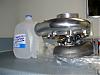
You could go with a large frame garrett TVXX with a dual scroll exhaust housing and do something like this to give you the same effect on the cheap...
You would be using half the housing AR when the gate is closed giving faster spool, and as soon as max boost is reached it opens and gives you full housing AR for max power...
The best part about it no ECU is required
You would be using half the housing AR when the gate is closed giving faster spool, and as soon as max boost is reached it opens and gives you full housing AR for max power...
The best part about it no ECU is required

It's not one of my build pics but it's exactly how I'm building my rear mount thumper... This is the actual picture...

Guys in junkyard DIY forums have been blocking off half of exhaust scrolls on big truck turbos for years to build boost when smaller AR housings were not available.
This will work... Just set the boost where you want (Being carful not to surge) and it will maintain by opening the second inlet to the exhaust housing. This increases the AR ratio which maintains boost by increasing the cross sectional area (exhaust flow) across the turbine, just like taking your thumb off of a garden hose... A second gate set a little higher or controlled with a boost controller, would be required once the first gate was fully opened and max AR was achieved. Depending on the combination a second gate may not be required...
I've thinking of ways of doing this internal to the housing for a couple of years and then this was posted on a mustang forum. This and other like builds have been kept hush, hush, why I don't know... Spread the word...
Guys in junkyard DIY forums have been blocking off half of exhaust scrolls on big truck turbos for years to build boost when smaller AR housings were not available.
This will work... Just set the boost where you want (Being carful not to surge) and it will maintain by opening the second inlet to the exhaust housing. This increases the AR ratio which maintains boost by increasing the cross sectional area (exhaust flow) across the turbine, just like taking your thumb off of a garden hose... A second gate set a little higher or controlled with a boost controller, would be required once the first gate was fully opened and max AR was achieved. Depending on the combination a second gate may not be required...
I've thinking of ways of doing this internal to the housing for a couple of years and then this was posted on a mustang forum. This and other like builds have been kept hush, hush, why I don't know...
Spread the word... 

Chris, I agree...
I'm building an older Garrett TV series with a twin scroll T6 housing using this design in a rear mount. I think if paired to a large compressor wheel w/anti-surge mated to a smaller turbine w/twin scroll housing it would be the perfect solution for a street-strip combo which would boost like crazy and then bypass to the second scroll for max flow and Horse Power. All without the need of electronics and could be controlled by a simple spring diaphragm wastegate…
I was blown away when I saw this picture and changed my design right then and there...
Here is the link that I've been following for sometime. Like I said, I completely over looked this solution and was trying to think of a way to achieve the same internal to the housing. When I saw this post it blew me away... Frank
http://www.theturboforums.com/smf/in...?topic=45148.0