








602 fwhp 383 ls6

If the heads were worked over and gone through by someone *capable* then there is no reason that this 383 couldn't do 500+rwhp. There are plenty on here that are pushing these kinds of numbers with proper setups.
A 232/241 isn't a small cam by any means either. Bigger cams don't always equal more power. As far as the heads go, 243 castings are well sought after and damn good in the hands of someone who knows what they're doing. They can move some serious air.
408's aren't lucky to hit and go beyond 500rwhp. It's the people who skimp on their head and intake selection and throw in some giant mis-matched cam that struggle to make or break 500rwhp.
A 232/241 isn't a small cam by any means either. Bigger cams don't always equal more power. As far as the heads go, 243 castings are well sought after and damn good in the hands of someone who knows what they're doing. They can move some serious air.
408's aren't lucky to hit and go beyond 500rwhp. It's the people who skimp on their head and intake selection and throw in some giant mis-matched cam that struggle to make or break 500rwhp.
I know bigger cams doesnt ALWAYS mean more power, but theres a bunch of plp running bigger cam than this in their stock cube LS1. That was my point. If I would build a 383 stroker, I would go bigger cam wise. Hell my next cam in my LS1 will bigger without beeing the biggest available!!
Contrary to the belief of most people on the LS boards, the majority of the best engine builders don't spend much if any of their time building LS motors. There are arenas in motorsports with a much more lucrative business model for building engines than trying to compete with the cookie cutter builds most prefer in our LS world. Aside from some of the unique intake flow characteristics on the LS based heads its just a small block chevy so any competent race engine builder can easily learn the differences and make an LS setup make the power.
How often do we actually see FWHP #'s on this board ? Call up TSP, or HKE etc... and ask what kind of FWHP #'s they've seen before raising the BS flag. Something else to consider is, this engine on the dyno more than likely had the optimum exhaust, no accessories, temp controlled enviroment, e-water pump etc.....
How often do we actually see FWHP #'s on this board ? Call up TSP, or HKE etc... and ask what kind of FWHP #'s they've seen before raising the BS flag. Something else to consider is, this engine on the dyno more than likely had the optimum exhaust, no accessories, temp controlled enviroment, e-water pump etc.....
EDIT - I just noticed that this is a road course car, so the cam is probally spec'd on a tighter LSA then normally what we see, maybe something on the lines of a 106... If this is true, then the LS6 would hold the motor back quite a bit. When you start getting into a tighter LSA cams, they become sensitive to the right setup. Also, it would make it to where this motor had next to nothing on the low range power, and still lazy in to the mid-range. Also, i noticed this person said a stock LS6 head with port work and bowls blended (the fact that he said bowels is a bit disturbing but none the less....), to get these heads to even remotely come close to feeding a 383 what it needs, those heads are goign to need to be cnc'd. If you look at the pics, those runners still look pretty damn rough. Also, what is the C261 number that is labeled on the head?
Last edited by Chris Gage; May 2, 2009 at 05:25 PM.
Ok, I live in Fort Myers and have for over 20 years and never heard of this shop. I understand tha ta 383 can hit 600+ at the flywheel, but not with this head/cam combo, just doesn't add up. A 383 needs a really good head to perform with its squareness... a 383 is a very wierd set-up on LS motors, but they will do well if the heads can flow extremely well. Not gonna happen with just a LS6 head, Its usually a small bore type head from AFR, ETP, TFS with the chambers opened up. I do say BS, but it really doesn't matter.... I just hope no on efrom this board buy's it, puts it in the car and only pumps out about 430rwhp on a chassis dyno. That is all that the is probaly worth.

On The Tree
Joined: Jun 2006
Posts: 139
Likes: 1
From: Kaleva, Michigan
Here is a car of a member here. Actually believe the guy works for AFR. This car is an example of a fully built, no corners skipped engine. 540rwhp. Probably not going to get that type of power unless your with an aftermarket head, like AFR.
http://videos.streetfire.net/video/5...02-A_58201.htm
http://videos.streetfire.net/video/5...02-A_58201.htm
I'm really curious as to why everyone believes this kind of power can't be achieved without the use of an "aftermarket" head, such as the AFR, TFS etc.? You do realize that before these heads were available, people were making SICK power with 243 and 317 castings, right? Well guess what? They still are.
I'm really curious as to why everyone believes this kind of power can't be achieved without the use of an "aftermarket" head, such as the AFR, TFS etc.? You do realize that before these heads were available, people were making SICK power with 243 and 317 castings, right? Well guess what? They still are.
I'm planning to keep my heads on a future 383 or 408, and they are ported 243s..but If I have the dough, I'll be all over TFS or AFR!
I'm really curious as to why everyone believes this kind of power can't be achieved without the use of an "aftermarket" head, such as the AFR, TFS etc.? You do realize that before these heads were available, people were making SICK power with 243 and 317 castings, right? Well guess what? They still are.
If 600 fwhp is that easy, wouldn't everyone be doing it?
243 heads, LS6 intake, fairly small cam, very light on the lift. Barely 11:1 compression. I call BS.
There are NOT very many 383s making over 500 rwhp. Actually they are few and far between. Compared to the amount of 403s/408s and bigger.
243 heads, LS6 intake, fairly small cam, very light on the lift. Barely 11:1 compression. I call BS.
There are NOT very many 383s making over 500 rwhp. Actually they are few and far between. Compared to the amount of 403s/408s and bigger.
LS1 Tech Stories
The Best V8 Stories One Small Block at Time

Topdon ONE vs. Artidiag 800 BT2: Which is the Diagnostic Tablet For You?
Pouria Savadkouei
Gas Monkey Built a 6-Wheel Ferrari Testarossa With a Corvette LT4 Engine
Verdad Gallardo
7 Most Reliable High-Performance Engines GM Has Ever Built
Verdad Gallardo
Amazing '71 Camaro Restomod Is Modern Muscle Car Under the Skin
Verdad Gallardo
6 Common C5 Corvette Failures and What's Involved In Repairing Them
Pouria Savadkouei
Retro Modern Bandit Pontiac Trans AM Comes With Burt Reynolds' Autograph
Verdad Gallardo
Top 10 Greatest Cadillac V Series Performance Models Ever, Ranked
Pouria Savadkouei
Top 10 Most Powerful Chevy Trucks Ever Made!

Hennessey's New Supercharged Silverado ZR2 Has 700 HP
Verdad Gallardo
Just dynoed my 383 with Afr 205's with 66cc chambers (right out the box) with -8cc wiseco pistons, ls6 intake, 30lbs svos, flp headers and it dynoed 430rwhp and 424trq. The numbers really dissapointed me. I guess once you add a fast 90/90 set up, underdrive pulley, mill and work the heads. I can see 500rwhp easy.
Car was dyno tuned at ARD with a DynoJet.
Car was dyno tuned at ARD with a DynoJet.

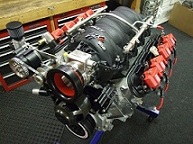
Originally built and freshened up by Joe’s Performance Racing Engines in Ft Myers, FL. “0” miles, no time on it since the freshened up. It's a 383 CID stroker crank, road racing, blueprinted, LS, long block assembly. This motor is really fast and ran a lap time of 2:18.4 in my 3000# Corvette on the Sebring International long course just before this recent rebuild. The last engine dyno run was 602 HP @ 6700 RPM w/ 532 # ft torque @ 3900 RPM at the flywheel. It comes with the original Superflow engine dyno sheet.
This LS long block motor includes the following parts:
Stock LS-6 heads with port work & bowel blending. 1.600” exhaust & 2.020 intakes
Crower roller cam with .570” intake lift & .559” exhaust lift and 232/241 degrees of duration @ 50
Forged Ross pistons with 11.5 to 1 compression ratio
This LS long block motor includes the following parts:
Stock LS-6 heads with port work & bowel blending. 1.600” exhaust & 2.020 intakes
Crower roller cam with .570” intake lift & .559” exhaust lift and 232/241 degrees of duration @ 50
Forged Ross pistons with 11.5 to 1 compression ratio
https://ls1tech.com/forums/dynamomet...-included.html
https://ls1tech.com/forums/generatio...big-power.html
https://ls1tech.com/forums/sponsor-s...gine-sale.html
Just dynoed my 383 with Afr 205's with 66cc chambers (right out the box) with -8cc wiseco pistons, ls6 intake, 30lbs svos, flp headers and it dynoed 430rwhp and 424trq. The numbers really dissapointed me. I guess once you add a fast 90/90 set up, underdrive pulley, mill and work the heads. I can see 500rwhp easy.
Car was dyno tuned at ARD with a DynoJet.
Car was dyno tuned at ARD with a DynoJet.
Everyone knows Tony Mamo's 383, right? AFR 225 heads, 242/248 solid roller .646/.653 114 LSA...
Some info on Mamo's 383:
https://ls1tech.com/forums/dynamomet...-included.html
https://ls1tech.com/forums/generatio...big-power.html
https://ls1tech.com/forums/sponsor-s...gine-sale.html
Some info on Mamo's 383:
https://ls1tech.com/forums/dynamomet...-included.html
https://ls1tech.com/forums/generatio...big-power.html
https://ls1tech.com/forums/sponsor-s...gine-sale.html

The numbers look like BS to me guys...
Not only is the peak torque hard to swallow given the displacement, overall build and list of components, but what is certainly not possible on that size engine is the RPM it claims to peak at (3900).
NO way no how would an engine of that displacement peak that early if it was capable of moving alot of air and producing big power....the two situtations are mutually exclusive of one another. My 383 was dialed in and with the advantage of higher flowing aftermarket parts and a solid roller cam mustered about 523 ft/lbs but note that peak occured at 4900-5000 RPM's which is more commonplace for a heavy breathing 383. Also note that even 523 is close to 1.4 ft/lbs per CID (1.37 to be exact) which is extremely strong for a pump gas engine. EMC winners are only in the low 1.4 range usually and they have a host of tricks to get there not associated with real street cars (basically they are pump gas extremely sophisticated race engines with ludicrous amounts of parts swapping and R&D involved in their development and they are aimed at very high specific torque values due to the limited RPM range in their testing with a peak of only 6500 RPM).
And dont try porting your "bowels" by yourself....LOL
-Tony
Not only is the peak torque hard to swallow given the displacement, overall build and list of components, but what is certainly not possible on that size engine is the RPM it claims to peak at (3900).
NO way no how would an engine of that displacement peak that early if it was capable of moving alot of air and producing big power....the two situtations are mutually exclusive of one another. My 383 was dialed in and with the advantage of higher flowing aftermarket parts and a solid roller cam mustered about 523 ft/lbs but note that peak occured at 4900-5000 RPM's which is more commonplace for a heavy breathing 383. Also note that even 523 is close to 1.4 ft/lbs per CID (1.37 to be exact) which is extremely strong for a pump gas engine. EMC winners are only in the low 1.4 range usually and they have a host of tricks to get there not associated with real street cars (basically they are pump gas extremely sophisticated race engines with ludicrous amounts of parts swapping and R&D involved in their development and they are aimed at very high specific torque values due to the limited RPM range in their testing with a peak of only 6500 RPM).
And dont try porting your "bowels" by yourself....LOL
-Tony


Yeah.....we got it....LOL
I was laughing before you brought our attention to it having caught it myself earlier in the thread.
Another thought I meant to share earlier focused once again on the claimed peak torque RPM is that this combination has a 2600 RPM gap between peak TQ and peak HP.....also NOT happening. Most engines have around 15-1600 or so and a 2000 RPM spread would be very strong indicative of a really good breathing combo that hangs the torque curve out there upstairs....more commonplace to see on a smaller engine with really good heads because it doesnt have as large an appetite for air up top and tends to hang on longer before falling off as quickly.
Also, I question why the seller wouldn' post the dyno sheet seeing he had it at his disposal....certainly seems like one of the first things you would post before all the pics of the engine!
Catch you guys later...
-Tony
I was laughing before you brought our attention to it having caught it myself earlier in the thread.
Another thought I meant to share earlier focused once again on the claimed peak torque RPM is that this combination has a 2600 RPM gap between peak TQ and peak HP.....also NOT happening. Most engines have around 15-1600 or so and a 2000 RPM spread would be very strong indicative of a really good breathing combo that hangs the torque curve out there upstairs....more commonplace to see on a smaller engine with really good heads because it doesnt have as large an appetite for air up top and tends to hang on longer before falling off as quickly.
Also, I question why the seller wouldn' post the dyno sheet seeing he had it at his disposal....certainly seems like one of the first things you would post before all the pics of the engine!
Catch you guys later...
-Tony
