









Fast 102mm Intake--Real Results --NO BS

Teching In
Joined: Dec 2006
Posts: 10
Likes: 0

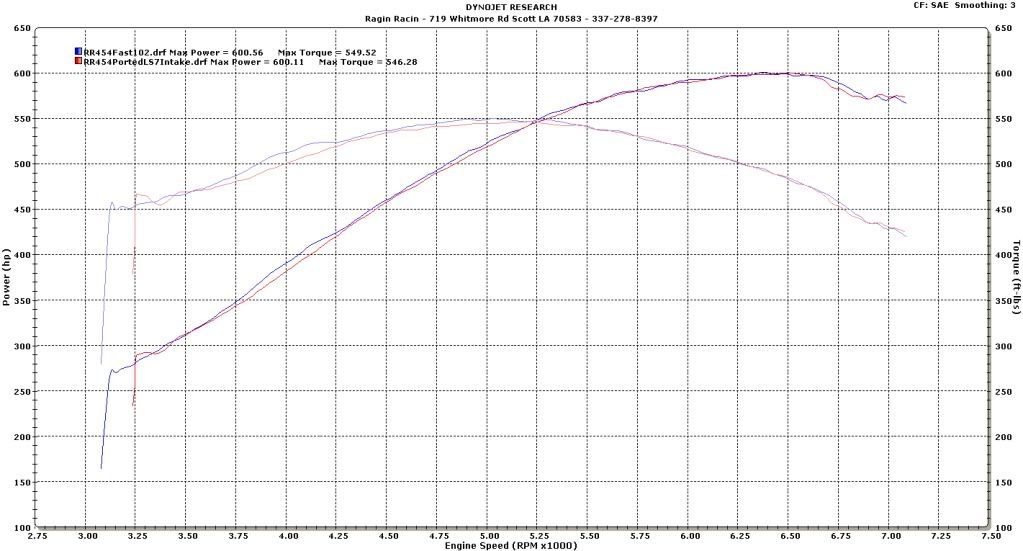
Tired of see BS threads on the new FAST 102. I was on the dyno with this thing all morning yesterday. To say the least I am very dissapointed. We put it on my 454 LSx that is doing 600rwhp expecting it to shine with this motor over our ported LS7 intake. I did everything I could to extract as much power as I could and it was evedent that this intake just didn't have it. We cleaned up the runners on the FAST to get everything as smooth as possible. You couldn't really open it up that much. We matched everything up using a boroscope just to make sure is was perfect. I do have plans to pull it off the car and take the intake apart and really port the whole thing out since cleaning it up didn't help at all. This will be done in the week or so. I will also be testing the use of a 100mm TB as well. Until then you can see there was absolutely no gain.
VG
TECH Fanatic


Joined: Aug 2005
Posts: 1,691
Likes: 1
From: Sunny London, UK
Considering the stated gains were only 11bhp over the stock one. A ported stock looks the way to go. $1100+ for a Fast102 with all the fuel rails and stuff you need is a waste.
Im not surprised there were little to no gains based on that.
Looks like Ill just be porting my throttle and nothing else then
Edited to add a couple of points from elsewhere.
What was your MAP kpa at WOT before and after the swap?
Are you sure your restirction isnt elsewhere? Intake filter, throttle etc?
Im not surprised there were little to no gains based on that.
Looks like Ill just be porting my throttle and nothing else then
Edited to add a couple of points from elsewhere.
What was your MAP kpa at WOT before and after the swap?
Are you sure your restirction isnt elsewhere? Intake filter, throttle etc?
Last edited by ringram; Jun 24, 2009 at 05:07 AM.
I do believe that it is very hard to compare the two as such. First off i believe we are all using the fast92 on the regular cathedral port as a reference to gain. The LS1/2/6 intakes did leave alot to be desired on the engine so of course the larger and better designed fast92 would out do them.
NOW fast forward to a couple of years later, where the head design has changed, runner style, fuel management, etc. BUT the designers of the LS7 intake did a very good job.
Had this intake out of the box been tested against a purely stock intake, im sure there would have been a gain. Then add in a larger than stock TB (which in drive by wire drop in for the LS7 is hard to come by) and then see what happens.
But, just as is normally shown with a fast92 in the hands of a veteran or skilled porter, and it REALLY shines. I am sure that shawn's ported intake was very well done. That being said, just like i said before, the ported v. ported results will be very interesting. Then it is more like comparing parts of equal modification to level the results.
I would not be too hasty to condemn the intake yet, but the results that ragin got are suprising.
NOW fast forward to a couple of years later, where the head design has changed, runner style, fuel management, etc. BUT the designers of the LS7 intake did a very good job.
Had this intake out of the box been tested against a purely stock intake, im sure there would have been a gain. Then add in a larger than stock TB (which in drive by wire drop in for the LS7 is hard to come by) and then see what happens.
But, just as is normally shown with a fast92 in the hands of a veteran or skilled porter, and it REALLY shines. I am sure that shawn's ported intake was very well done. That being said, just like i said before, the ported v. ported results will be very interesting. Then it is more like comparing parts of equal modification to level the results.
I would not be too hasty to condemn the intake yet, but the results that ragin got are suprising.
Would like to see some testing on a "smaller" 427ci engine as well performed with ported LS7 heads and healthy cam setup. Meaning one that makes 550-575rwhp+ with ported LS7 intake in place on pump gas (91 or 93 octane).
I've been crunching the numbers and unless the new 102mm FAST makes the previously claimed power over a ported LS7 intake (which most people have)..... it isn't worth it.
Approx costs:
$979 FAST 102mm intake
$100 LS3 fuel rail
$350 for new injectors (as the stock short LS7 injectors won't work)
$300-400 retune
Nearly $1800 total in parts!
I've been crunching the numbers and unless the new 102mm FAST makes the previously claimed power over a ported LS7 intake (which most people have)..... it isn't worth it.
Approx costs:
$979 FAST 102mm intake
$100 LS3 fuel rail
$350 for new injectors (as the stock short LS7 injectors won't work)
$300-400 retune
Nearly $1800 total in parts!

LS1Tech Sponsor
Joined: Feb 2006
Posts: 1,170
Likes: 1
From: Rockfield Kentucky
You have to be very careful when testing parts on the dyno. If you have hit a limit any any of the engines other components your not going to see much change. Lets say the head or cam is the limiting factor, then changing the manifold won't fix the probelm with the heads or cam.
While I applaud your honesty I would like to see the specs on the entire combination.
Also would be good to test on an engine that is clearly intake limited.
Robin
While I applaud your honesty I would like to see the specs on the entire combination.
Also would be good to test on an engine that is clearly intake limited.
Robin
You have to be very careful when testing parts on the dyno. If you have hit a limit any any of the engines other components your not going to see much change. Lets say the head or cam is the limiting factor, then changing the manifold won't fix the probelm with the heads or cam.
While I applaud your honesty I would like to see the specs on the entire combination.
Also would be good to test on an engine that is clearly intake limited.
Robin
While I applaud your honesty I would like to see the specs on the entire combination.
Also would be good to test on an engine that is clearly intake limited.
Robin
Ragin's motor had more cubes.
Ragin's motor had a bigger cam.
Ragin's motor made more baseline power.
Taking these points into account, one would expect the airflow demand on Ragin's motor to be more than Katech's and that the gains going to the FAST 102 would be significant. The fact that they were not makes me scratch my head.
__________________

2013 Corvette Grand Sport A6 LME forged 416, Greg Good ported TFS 255 LS3 heads, 222/242 .629"/.604" 121LSA Pat G blower cam, ARH 1 7/8" headers, ESC Novi 1500 Supercharger w/8 rib direct drive conversion, 747rwhp/709rwtq on 93 octane, 801rwhp/735rwtq on race fuel, 10.1 @ 147.25mph 1/4 mile, 174.7mph Half Mile.
2016 Corvette Z51 M7 Magnuson Heartbeat 2300 supercharger, TSP LT headers, Pat G tuned, 667rwhp, 662rwtq, 191mph TX Mile.
2009.5 Pontiac G8 GT 6.0L, A6, AFR 230v2 heads. 506rwhp/442rwtq. 11.413 @ 121.29mph 1/4 mile, 168.7mph TX Mile
2000 Pewter Ram Air Trans Am M6 heads/cam 508 rwhp/445 rwtq SAE, 183.092 TX Mile
2022 Cadillac Escalade 6.2L A10 S&B CAI, Corsa catback.
2023 Corvette 3LT Z51 soon to be modified.
Custom LSX tuning in person or via email press here.
2013 Corvette Grand Sport A6 LME forged 416, Greg Good ported TFS 255 LS3 heads, 222/242 .629"/.604" 121LSA Pat G blower cam, ARH 1 7/8" headers, ESC Novi 1500 Supercharger w/8 rib direct drive conversion, 747rwhp/709rwtq on 93 octane, 801rwhp/735rwtq on race fuel, 10.1 @ 147.25mph 1/4 mile, 174.7mph Half Mile.
2016 Corvette Z51 M7 Magnuson Heartbeat 2300 supercharger, TSP LT headers, Pat G tuned, 667rwhp, 662rwtq, 191mph TX Mile.
2009.5 Pontiac G8 GT 6.0L, A6, AFR 230v2 heads. 506rwhp/442rwtq. 11.413 @ 121.29mph 1/4 mile, 168.7mph TX Mile
2000 Pewter Ram Air Trans Am M6 heads/cam 508 rwhp/445 rwtq SAE, 183.092 TX Mile
2022 Cadillac Escalade 6.2L A10 S&B CAI, Corsa catback.
2023 Corvette 3LT Z51 soon to be modified.
Custom LSX tuning in person or via email press here.
LS1 Tech Stories
The Best V8 Stories One Small Block at Time

Topdon ONE vs. Artidiag 800 BT2: Which is the Diagnostic Tablet For You?
Pouria Savadkouei
Gas Monkey Built a 6-Wheel Ferrari Testarossa With a Corvette LT4 Engine
Verdad Gallardo
7 Most Reliable High-Performance Engines GM Has Ever Built
Verdad Gallardo
Amazing '71 Camaro Restomod Is Modern Muscle Car Under the Skin
Verdad Gallardo
6 Common C5 Corvette Failures and What's Involved In Repairing Them
Pouria Savadkouei
Retro Modern Bandit Pontiac Trans AM Comes With Burt Reynolds' Autograph
Verdad Gallardo
Top 10 Greatest Cadillac V Series Performance Models Ever, Ranked
Pouria Savadkouei
Top 10 Most Powerful Chevy Trucks Ever Made!

Hennessey's New Supercharged Silverado ZR2 Has 700 HP
Verdad Gallardo LS1Tech Sponsor
Joined: Feb 2006
Posts: 1,170
Likes: 1
From: Rockfield Kentucky
Exactly my point,
I have never seen dyno sheets from 2 intakes look so much alike. I am not saying it's not possible but they sure are close.
A small block 454 hits a lot of hurdles with some of the heads out there. Still I would have expected the torque and or power peaks to be different in some way.
Robin
I have never seen dyno sheets from 2 intakes look so much alike. I am not saying it's not possible but they sure are close.
A small block 454 hits a lot of hurdles with some of the heads out there. Still I would have expected the torque and or power peaks to be different in some way.
Robin
 Fuel Rail
 With the stock LS7 injectors, an LS2/LS3 fuel rail will also work using (8) #54026IA injector adapters and (8) #146020COR o-rings. There is also a GM o-ring that will substitute but I don't have the number handy. Adapters and o-rings go for less than $50 not counting shipping.

well yes you mean also using the kit that comp has. i was just informing the peeps that you dont ONLY have to use a tall injector. COMP will have both kits available shortly for the use of either injector



Would like to see some testing on a "smaller" 427ci engine as well performed with ported LS7 heads and healthy cam setup. Meaning one that makes 550-575rwhp+ with ported LS7 intake in place on pump gas (91 or 93 octane).
I've been crunching the numbers and unless the new 102mm FAST makes the previously claimed power over a ported LS7 intake (which most people have)..... it isn't worth it.
Approx costs:
$979 FAST 102mm intake
$100 LS3 fuel rail
$350 for new injectors (as the stock short LS7 injectors won't work)
$300-400 retune
Nearly $1800 total in parts!
I've been crunching the numbers and unless the new 102mm FAST makes the previously claimed power over a ported LS7 intake (which most people have)..... it isn't worth it.
Approx costs:
$979 FAST 102mm intake
$100 LS3 fuel rail
$350 for new injectors (as the stock short LS7 injectors won't work)
$300-400 retune
Nearly $1800 total in parts!


TECH Addict
Joined: Jul 2002
Posts: 2,261
Likes: 0
Thanks TLewis4095.
Very interesting read. Where did this come from??
Very interesting read. Where did this come from??
(and the rest)...... I learned this lesson myself when my partners Buddy Morrison and Lee Shepherd built our first flow bench in the mid-'70s. It was a great contraption that could just about suck the windows out of our rented shop on Arkansas Lane. While this homebuilt test bench boosted our racing program, it certainly didn't make us engine experts overnight - even though we initially thought we had found the key to the vault of knowledge.
We had been racing 287-cubic-inch small-blocks in various Modified and Comp classes before we decided to make the move to Pro Stock with a 331ci engine. (Students of Pro Stock history will recall that the '70s was the era of weight breaks for various engine and chassis combinations.) We were determined to be "scientific" in our approach, and reasoned that a 15 percent increase in engine displacement demanded a 15 percent increase in airflow. We dutifully enlarged the ports, increased the valve diameters, and hit our airflow targets. We set off to conquer the world of Pro Stock - but our pride and joy was a dog.
After struggling to even qualify in our initial outings, we pulled an old pair of Modified heads off the shelf. Lee worked on the ports for an afternoon, we bolted them on our Pro Stock short-block, and we qualified fifth at Englishtown in our next race.
If you went strictly by the flow numbers, those heads would hardly enough air to satisfy a respectable big-inch bracket racing engine - and yet they were magic on the race track. That was when I realized that cfm isn't everything. It's a lesson that I have seen repeated countless times in the last 25 years.
A flow bench measures air movement in a very rudimentary way - steady-state flow at a constant depression (vacuum). Obviously the conditions that exist inside a running engine are quite different. The flow bench can't simulate the effects of the pistons going up and down, the reversion pulses as the valves open and close, the sonic waves that resonate inside the runners, the inertia of the fuel droplets, and all of the other phenomena that influence engine performance in the real world. When you flow test a cylinder head, you are simply measuring how far you can move the liquid in a manometer.
The bigger you make a port, the more it flows. That's hardly shocking news. Bolt a sewer pipe onto a flow bench and it will generate terrific flow numbers. So should we use ports as big as sewer pipes on our race cars? The flow bench says we should - the time slip says something completely different.
If airflow were everything, we would all use the longest duration camshafts we could find - after all, more duration means more flow. In fact we know that there is a finite limit to how long the valves can be open before performance
suffers. That is because the valve events have to be in harmony with the rest of the engine.
The same principle applies to cylinder heads. Simple airflow capacity should never be the first consideration in evaluating cylinder heads. Characteristics that are far more important include air speed, port cross section, port volume and shape, and the relationship between the size of the throat and the valve seat. If these attributes are wrong, you can work forever on the flow bench and not overcome the fundamental flaws.
Here is a do-it-yourself example: Turn on a garden hose and the water will dribble out a couple of feet. Now put a nozzle on the hose and the water will spray across your backyard. The water pressure and volume haven't changed, but the velocity has increased dramatically. Now think about the air and fuel going into your engine's cylinders. Which would you prefer: slow and lazy or fast and responsive?
An engineer will tell you that an engine requires a prescribed amount of air and fuel to produce "X" horsepower. In a perfect world, that may be true - but we race with imperfect engines. The shape and cross-sectional area of the runners are absolutely critical to performance. For example, I have two sets of Pro Stock cylinder heads that produce nearly identical flow numbers, yet one pair produces nearly 150 more horsepower at 9,200 rpm than the other. The flow bench can't tell the difference between them, but the engine certainly can.
There are software programs that claim to be able to predict an engine's performance based on airflow numbers. Unfortunately, a critical shortcoming of many of these programs is that they are based on inaccurate information or false assumptions. A computer is an excellent calculator, but it is not an experienced engine builder. The software doesn't know whether a port's short-turn radius is shaped properly, whether the flow is turbulent at critical valve lifts, or whether the flame speed is fast enough. Racers have a tendency to believe that computers are infallible, so they accept the software's solutions as gospel, when in fact they may be badly flawed.
Textbooks would lead you to believe that an exhaust to intake flow ratio of 80 percent is ideal - yet a typical Pro Stock head has exhaust ports that flow less than 60 percent of the intake runners. You can improve the exhaust flow
tremendously with about 40 minutes of work with a hand grinder - but the supposed improvements will just about kill the engine's on-track performance. I know because I've been there.
We have also learned that low-lift flow (meaning anything below .400-inch valve lift in a Pro Stock engine with a .900-inch lift camshaft) is relatively unimportant. Think about the valve events in a racing engine: From the point when the valve first moves off its seat until it reaches mid-lift, the piston is either going the wrong way (that is, it is rising in the cylinder) or it's parked near TDC. The piston doesn't begin to move away from the combustion chamber with enough velocity to lower the pressure in the cylinder until the valve is nearly halfway open. Consequently it is high-lift flow that really matters in a drag racing engine.
The shape of the combustion chamber also has a significant impact on performance. A conventional chamber with deep reliefs around the valve seats and a relatively flat valve seat angle can produce terrific flow at .200 to .300-inch valve lift. Today a state-of-the-art chamber typically has 55-degree valve seats and steep walls that guide the air/fuel mixture into the cylinder to enhance high-lift flow This doesn't mean that every racer needs state-of-the-art Pro Stock cylinder heads - along with the high maintenance they require. The heads have to match the application. Conventional combustion chambers and 45-degree valve seats are just fine for a dependable, low-maintenance racing engine that will run a full season between overhauls.
The classic Hemi combustion chamber is capable of producing impressive flow figures, but it's not going to make impressive power. Engine technology in all forms of motorsports is converging around smaller, high-efficiency combustion chamber designs. You can see the result in lower brake specific fuel consumption (BSFC) numbers, which indicate improved engine efficiency. Twenty years ago, a racing engine with a .48 BSFC was considered very good; today's competition engines produce BSFC numbers in the neighborhood of .35. This means that a given quantity of fuel is being atomized and burned more effectively to produce more power. A cylinder head's combustion efficiency can't be measured on a flow bench, yet it has a huge impact on performance.
I am not against flow benches; in fact, we use computerized flow benches daily at Reher-Morrison Racing Engines. What I am against is over reliance on flow numbers as the primary measurement of a cylinder head's performance. A flow bench is a valuable tool that can help a racer fine tune a combination - but it is not the ultimate authority.
This is more info than most were looking for I expect, but invaluable info when seeking to understand the reality behind flow numbers. If the intake charge does not flow with sufficient velocity to move through the entire "air pump" that our motors are, peak power cannot be realized.
As for the FAST 102 being worthwhile, independant testing such as Ragin's and company will be the real test and we may find that adding the 100mm TB may not do the trick.....but with the proper heads, cam profile, and exhaust as long as there is not a bottle neck or restriction in any of the key areas, I suspect we will see these make good power. If not, it will be a first for the FAST line of intake manifolds.
We had been racing 287-cubic-inch small-blocks in various Modified and Comp classes before we decided to make the move to Pro Stock with a 331ci engine. (Students of Pro Stock history will recall that the '70s was the era of weight breaks for various engine and chassis combinations.) We were determined to be "scientific" in our approach, and reasoned that a 15 percent increase in engine displacement demanded a 15 percent increase in airflow. We dutifully enlarged the ports, increased the valve diameters, and hit our airflow targets. We set off to conquer the world of Pro Stock - but our pride and joy was a dog.
After struggling to even qualify in our initial outings, we pulled an old pair of Modified heads off the shelf. Lee worked on the ports for an afternoon, we bolted them on our Pro Stock short-block, and we qualified fifth at Englishtown in our next race.
If you went strictly by the flow numbers, those heads would hardly enough air to satisfy a respectable big-inch bracket racing engine - and yet they were magic on the race track. That was when I realized that cfm isn't everything. It's a lesson that I have seen repeated countless times in the last 25 years.
A flow bench measures air movement in a very rudimentary way - steady-state flow at a constant depression (vacuum). Obviously the conditions that exist inside a running engine are quite different. The flow bench can't simulate the effects of the pistons going up and down, the reversion pulses as the valves open and close, the sonic waves that resonate inside the runners, the inertia of the fuel droplets, and all of the other phenomena that influence engine performance in the real world. When you flow test a cylinder head, you are simply measuring how far you can move the liquid in a manometer.
The bigger you make a port, the more it flows. That's hardly shocking news. Bolt a sewer pipe onto a flow bench and it will generate terrific flow numbers. So should we use ports as big as sewer pipes on our race cars? The flow bench says we should - the time slip says something completely different.
If airflow were everything, we would all use the longest duration camshafts we could find - after all, more duration means more flow. In fact we know that there is a finite limit to how long the valves can be open before performance
suffers. That is because the valve events have to be in harmony with the rest of the engine.
The same principle applies to cylinder heads. Simple airflow capacity should never be the first consideration in evaluating cylinder heads. Characteristics that are far more important include air speed, port cross section, port volume and shape, and the relationship between the size of the throat and the valve seat. If these attributes are wrong, you can work forever on the flow bench and not overcome the fundamental flaws.
Here is a do-it-yourself example: Turn on a garden hose and the water will dribble out a couple of feet. Now put a nozzle on the hose and the water will spray across your backyard. The water pressure and volume haven't changed, but the velocity has increased dramatically. Now think about the air and fuel going into your engine's cylinders. Which would you prefer: slow and lazy or fast and responsive?
An engineer will tell you that an engine requires a prescribed amount of air and fuel to produce "X" horsepower. In a perfect world, that may be true - but we race with imperfect engines. The shape and cross-sectional area of the runners are absolutely critical to performance. For example, I have two sets of Pro Stock cylinder heads that produce nearly identical flow numbers, yet one pair produces nearly 150 more horsepower at 9,200 rpm than the other. The flow bench can't tell the difference between them, but the engine certainly can.
There are software programs that claim to be able to predict an engine's performance based on airflow numbers. Unfortunately, a critical shortcoming of many of these programs is that they are based on inaccurate information or false assumptions. A computer is an excellent calculator, but it is not an experienced engine builder. The software doesn't know whether a port's short-turn radius is shaped properly, whether the flow is turbulent at critical valve lifts, or whether the flame speed is fast enough. Racers have a tendency to believe that computers are infallible, so they accept the software's solutions as gospel, when in fact they may be badly flawed.
Textbooks would lead you to believe that an exhaust to intake flow ratio of 80 percent is ideal - yet a typical Pro Stock head has exhaust ports that flow less than 60 percent of the intake runners. You can improve the exhaust flow
tremendously with about 40 minutes of work with a hand grinder - but the supposed improvements will just about kill the engine's on-track performance. I know because I've been there.
We have also learned that low-lift flow (meaning anything below .400-inch valve lift in a Pro Stock engine with a .900-inch lift camshaft) is relatively unimportant. Think about the valve events in a racing engine: From the point when the valve first moves off its seat until it reaches mid-lift, the piston is either going the wrong way (that is, it is rising in the cylinder) or it's parked near TDC. The piston doesn't begin to move away from the combustion chamber with enough velocity to lower the pressure in the cylinder until the valve is nearly halfway open. Consequently it is high-lift flow that really matters in a drag racing engine.
The shape of the combustion chamber also has a significant impact on performance. A conventional chamber with deep reliefs around the valve seats and a relatively flat valve seat angle can produce terrific flow at .200 to .300-inch valve lift. Today a state-of-the-art chamber typically has 55-degree valve seats and steep walls that guide the air/fuel mixture into the cylinder to enhance high-lift flow This doesn't mean that every racer needs state-of-the-art Pro Stock cylinder heads - along with the high maintenance they require. The heads have to match the application. Conventional combustion chambers and 45-degree valve seats are just fine for a dependable, low-maintenance racing engine that will run a full season between overhauls.
The classic Hemi combustion chamber is capable of producing impressive flow figures, but it's not going to make impressive power. Engine technology in all forms of motorsports is converging around smaller, high-efficiency combustion chamber designs. You can see the result in lower brake specific fuel consumption (BSFC) numbers, which indicate improved engine efficiency. Twenty years ago, a racing engine with a .48 BSFC was considered very good; today's competition engines produce BSFC numbers in the neighborhood of .35. This means that a given quantity of fuel is being atomized and burned more effectively to produce more power. A cylinder head's combustion efficiency can't be measured on a flow bench, yet it has a huge impact on performance.
I am not against flow benches; in fact, we use computerized flow benches daily at Reher-Morrison Racing Engines. What I am against is over reliance on flow numbers as the primary measurement of a cylinder head's performance. A flow bench is a valuable tool that can help a racer fine tune a combination - but it is not the ultimate authority.
This is more info than most were looking for I expect, but invaluable info when seeking to understand the reality behind flow numbers. If the intake charge does not flow with sufficient velocity to move through the entire "air pump" that our motors are, peak power cannot be realized.
As for the FAST 102 being worthwhile, independant testing such as Ragin's and company will be the real test and we may find that adding the 100mm TB may not do the trick.....but with the proper heads, cam profile, and exhaust as long as there is not a bottle neck or restriction in any of the key areas, I suspect we will see these make good power. If not, it will be a first for the FAST line of intake manifolds.


w.Rehermorrison.com, tech talk. I attened their racing engine building school and the amount of R&D that goes on there is amazing. Wet flow bench under a blacklight showed flow related stuff I never imagined. David Reher is a family friend as well.

I about expected this. The Katech engine dyno showed stock to stock advantage on a mild engine about 11HP. The 102mm TB didn't show much more - maybe 14HP max with a loss of torque. Most ported LS7 manifolds are gaining 10rwhp or more. Ported LS7 vs stock FAST it should be about equal. The problem is the FAST was touched up and still showed nothing here.
DRM has said that there are ridges at the base of the manifold designed to increase velocity (old motorcycle trick). I wonder if "touching" those up killed off some velocity of the FAST?
The other odd thing is, Katech has only seen 2HP with a ported LS7 manifold, but who knows who did the porting, etc. However, to play the devil's advocate and assume this is true, then a stock FAST should outpower a "ported" LS7 by around 9HP. If one "ports" the FAST and murders its velocity, then maybe that's why there is no gain. Not that I believe it, but it is a theory.
DRM has said that there are ridges at the base of the manifold designed to increase velocity (old motorcycle trick). I wonder if "touching" those up killed off some velocity of the FAST?
The other odd thing is, Katech has only seen 2HP with a ported LS7 manifold, but who knows who did the porting, etc. However, to play the devil's advocate and assume this is true, then a stock FAST should outpower a "ported" LS7 by around 9HP. If one "ports" the FAST and murders its velocity, then maybe that's why there is no gain. Not that I believe it, but it is a theory.

what's the maf size and the airlid opening size you used?
I think for a fair comparison the larger airlid, maf and tb will have to be used before it can be said that there's no improvement to be had.
being that it took SOOOOOOOOOO long for these intakes to actually come out I think we all knew that getting power out of them wouldn't be as easy as just bolting it on.
I think for a fair comparison the larger airlid, maf and tb will have to be used before it can be said that there's no improvement to be had.
being that it took SOOOOOOOOOO long for these intakes to actually come out I think we all knew that getting power out of them wouldn't be as easy as just bolting it on.
what's the maf size and the airlid opening size you used?
I think for a fair comparison the larger airlid, maf and tb will have to be used before it can be said that there's no improvement to be had.
being that it took SOOOOOOOOOO long for these intakes to actually come out I think we all knew that getting power out of them wouldn't be as easy as just bolting it on.
I think for a fair comparison the larger airlid, maf and tb will have to be used before it can be said that there's no improvement to be had.
being that it took SOOOOOOOOOO long for these intakes to actually come out I think we all knew that getting power out of them wouldn't be as easy as just bolting it on.