

Truck Coils MYTH PROVEN INSIDE

edcmat-l1, if you do that testing, please keep in mind what the stock dwell settings are in vehicles running the respective coils you're testing. While you're right about what different coils might be capable of...how long are they capable of it if the dwell time is cranked up higher than stock? Stock dwell settings from a truck are different than an LS1 car, and stock dwell settings seem to result in coils lasting a very very very long time...when I put my D585's on my Camaro, I also opened up the tune from my friends 2002 Yukon that I did this past spring (that has D585's stock) and copied ALL dwell related stuff into my cars tune.
So me personally, I'd like to know what they're all doing, at the dwell settings that GM decided to control them with, not what they're capable of if the dwell goes up...because none of us on here have the equipment to do a failure or life cycle analysis on the coils if the dwell times are turned up.
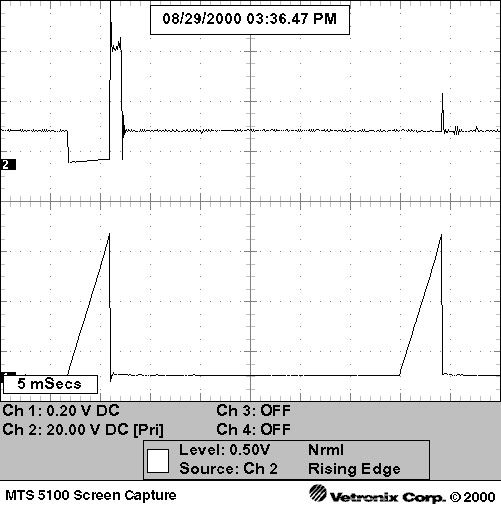
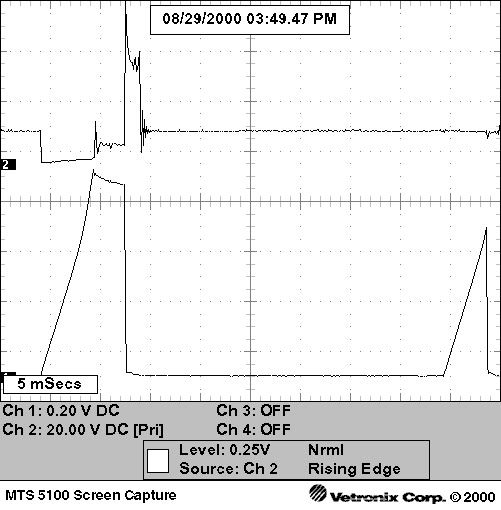
Second, and this is gathered info from other ignition systems, not necessarily LS based, but MOST later model PCM driven ignition systems havee current limiting features, that do just that. If the dwell time exceeds XX amount of time, they go into current limiting mode. It's evident on a scope, as the voltage that's normally pulled down to ground, will have a step in it, where it's no longer pulled down to ground, but is pulled down about half way. Basically going into a mode where it has not yet released the "pull down", but is at or past the point of coil saturation, and the semiconductor/driver knows it, and limits any further build up of current, or flow of electrons into the primary winding.
Below is a scope shot of a common coil charge and discharge. What you're looking at, the top trace, channel 2 is primary voltage. 12+ volts are applied to one side of the coil. That's the line starting at the left. The voltage is "pulled down" by what ever switching device, in this case the PCM. The bottom trace is the actual coil amperage, taken with an inductive pickup. What you're watching in the bottom trace is electrons rushing in to saturate the primary side of the coil. Back to the top trace. After the coil is near saturation, the "pull down" is released, that is the sharp step up, and the inductive spike upward, past the top of the screen. This is the collapse of the primary coil, and the bottom trace shows the collapse as a straight downward line as the electrons basically evacuate the premises. Back to the top trace, the squiggly line after the high inductive spike is the spark jumping the gap of the plug, or "burn time"
The scope shot below is the same car, same ignition system, but longer dwell time. You can clearly see the system go into currently limiting mode. It is evident by the step up in the top trace, the primary voltage. The dwell time is clearly longer, causing a higher level of coil saturation, and for whatever reason the driver didn't like it, and the last few milliseconds, the voltage was pulled down to about approx 5 or 6 volts, as opposed to being pulled down to ground, clearly limiting the amount of coil saturation, and therefore the amount of primary/secondary output. I've done tons of reasearch and have found no clear answer as to why this happens with different systems, the only thing I can come up with is sef preservation.
Wew!! After all that, the moral of the story is, (and I haven't confirmed on these particular systems) these late model ignition systems are so far advanced, that chances are regardless what we do to them, modify the dwell, swap coils, whatever, that they are going to perform to a level that's adequate, not much more.
If we crank up the dwell too high, chances are they'll go into current limiting mode to save themselves. If we put higher output coils on, chances are they're only going to output enough spark energy to get the job done. After all, that exactly how they function.
Thats really cool info. I had no idea that the LS1 PCM (though I recognize you said you haven't verified the LS1 PCM yet) would be abe to step the voltage down like that based on the coil and not on the dwell time in it's lookup tables.
Thank you for teaching me something new.
Thank you for teaching me something new.
Went to the dyno today and did a back to back dyno on the truck coils/stock ls1 coils. I did two dynos with each. The results were I gained 3 Hp and 2 Tq going back with my ls1 coils. So basically in my application they did not gain anything. My car is a 99 z28 cam only full bolt on car. Take it as you will. This is just my results.
very impressive.
have you tested the response of the circuit with the ls1/truck coils? is there a chance that whatever is controlling this current limiter has the ability to dynamically adjust itself to coil specifications, perhaps the engineers would do this for flexibility toward future applications, or future problems/recalls with current coils?
coils are not coils are not coils...
Nope, because that is not always a true statement. The cam design, valve events, cylinder fill, overlap etc play into the cylinder pressure.
LS1 Tech Stories
The Best V8 Stories One Small Block at Time

Topdon ONE vs. Artidiag 800 BT2: Which is the Diagnostic Tablet For You?
Pouria Savadkouei
Gas Monkey Built a 6-Wheel Ferrari Testarossa With a Corvette LT4 Engine
Verdad Gallardo
7 Most Reliable High-Performance Engines GM Has Ever Built
Verdad Gallardo
Amazing '71 Camaro Restomod Is Modern Muscle Car Under the Skin
Verdad Gallardo
6 Common C5 Corvette Failures and What's Involved In Repairing Them
Pouria Savadkouei
Retro Modern Bandit Pontiac Trans AM Comes With Burt Reynolds' Autograph
Verdad Gallardo
Top 10 Greatest Cadillac V Series Performance Models Ever, Ranked
Pouria Savadkouei
Top 10 Most Powerful Chevy Trucks Ever Made!

Hennessey's New Supercharged Silverado ZR2 Has 700 HP
Verdad Gallardo

I made 449rwhp with a 91 octane pump gas drinking 347ci motor through a 4L80E with stock plug wires that I have fixed numerous times.. Oh and car coils... I think if it's working, there is no reason to change.. But, if it's not, then there is.. If you can buy them used, try it. If it does nothing for you, sell them.

TECH Regular
Joined: Jun 2010
Posts: 448
Likes: 0
www.aquapulser.com
Someone give this a try if there is no gain then no plug coil or wire is going to make any difference.
Someone give this a try if there is no gain then no plug coil or wire is going to make any difference.


so how much is it safe to bump the dwel time on both ls1 coils and a car running truck coils? i have 2 ls1 cars and have truck coils on my Nova. Never thought to bump the dwell time up. THis is something i can try next time at the track to see back to back differences

ok so trying to sift through the arguing, i cant find a conclusion. Here's a good example for debate...i have both ls1 coils, and 6.0 truck coils. already have both of them. it costs me nothing. that being the case, which ones should i use??