






Whats more important HP or torque?

Thread Starter
TECH Enthusiast
iTrader: (2)
Joined: Dec 2006
Posts: 696
Likes: 0
From: Gloucester VA
 Whats more important HP or torque?
 I have noticed some people post High rwhp and have big number gap between torque. I did not think my car dynoed that high but the torque was only about 20 less than the RWHP. 386rwhp and 363 torque. The car pulls pretty hard. I have not had it to track yet but will as soon as I get some free time.
On The Tree
Joined: May 2008
Posts: 187
Likes: 0
From: MIDDLE GA.

TECH Fanatic
Joined: Nov 2004
Posts: 1,251
Likes: 0
From: Tuscaloosa, AL.
Horsepower is imaginary. it is a calculation of torque.
Horsepower = Torque x RPM / 5252
Here is my dyno graph for instance.
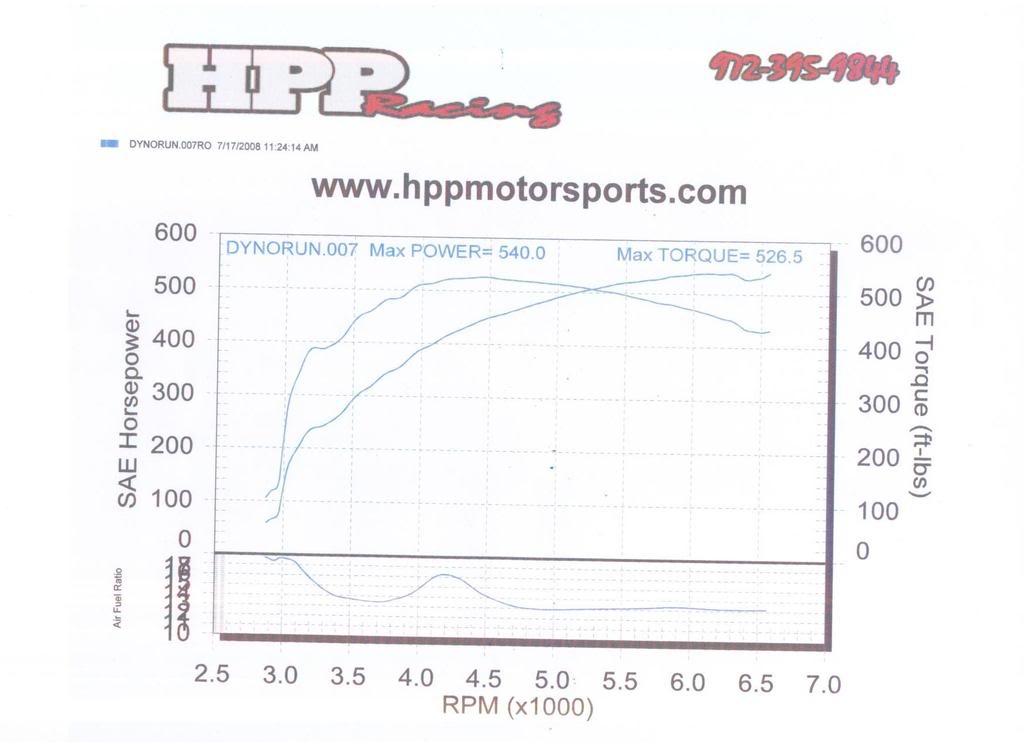
Do you see how the torque curve and HP curve cross at 5252 RPMS??? That is because at 5252 RPMs the equation has a conversion ratio of 1, thus HP=TQ.
Remember, Your engine produces torque and torque only. Torque is the rotational force that the engine produces on the crank shaft.
Now, what you should have asked is "Do I want to make power at lower RPMS or Higher RPMS". If your engine makes more power (read torque) at lower RPMS, then your peak torque number will be high. This will give you low end power and the car will feel more sporty and more fun to drive.
If you make your power in the higher RPMs, then your peak torque will be low, but your peak HP will be high. The car will feel sluggish when driving around town. However, it is typically thought that you will run faster in a straight line race situation. The reason is that in a 1/4 mile race you will spend most of your time in the high RPMs.
However, there are trade offs. If you don't make power untill way late then you may not be able to get into your power band early enough. Regardless, the cam selection is the deciding factor on where you make your power (read TQ). High lift cams tend to make TQ higher in the RPMS (which equates to higher peak HP.
BTW, if this is over your head or you really don't want to understand how and why your car makes power, then the standard "TQ wins races, HP sells cars" is as good a motto as any I Suppose.
Horsepower = Torque x RPM / 5252
Here is my dyno graph for instance.
Do you see how the torque curve and HP curve cross at 5252 RPMS??? That is because at 5252 RPMs the equation has a conversion ratio of 1, thus HP=TQ.
Remember, Your engine produces torque and torque only. Torque is the rotational force that the engine produces on the crank shaft.
Now, what you should have asked is "Do I want to make power at lower RPMS or Higher RPMS". If your engine makes more power (read torque) at lower RPMS, then your peak torque number will be high. This will give you low end power and the car will feel more sporty and more fun to drive.
If you make your power in the higher RPMs, then your peak torque will be low, but your peak HP will be high. The car will feel sluggish when driving around town. However, it is typically thought that you will run faster in a straight line race situation. The reason is that in a 1/4 mile race you will spend most of your time in the high RPMs.
However, there are trade offs. If you don't make power untill way late then you may not be able to get into your power band early enough. Regardless, the cam selection is the deciding factor on where you make your power (read TQ). High lift cams tend to make TQ higher in the RPMS (which equates to higher peak HP.
BTW, if this is over your head or you really don't want to understand how and why your car makes power, then the standard "TQ wins races, HP sells cars" is as good a motto as any I Suppose.
Trending Topics
LS1 Tech Stories
The Best V8 Stories One Small Block at Time

Topdon ONE vs. Artidiag 800 BT2: Which is the Diagnostic Tablet For You?
Pouria Savadkouei
Gas Monkey Built a 6-Wheel Ferrari Testarossa With a Corvette LT4 Engine
Verdad Gallardo
7 Most Reliable High-Performance Engines GM Has Ever Built
Verdad Gallardo
Amazing '71 Camaro Restomod Is Modern Muscle Car Under the Skin
Verdad Gallardo
6 Common C5 Corvette Failures and What's Involved In Repairing Them
Pouria Savadkouei
Retro Modern Bandit Pontiac Trans AM Comes With Burt Reynolds' Autograph
Verdad Gallardo
Top 10 Greatest Cadillac V Series Performance Models Ever, Ranked
Pouria Savadkouei
Top 10 Most Powerful Chevy Trucks Ever Made!

Hennessey's New Supercharged Silverado ZR2 Has 700 HP
Verdad Gallardo
"It takes one HP to raise a 550 pound weight up one foot in one second."
-DynoJet Research
Horsepower is just a measurement of work your engine can do over a given amount of time.
Torque is the turning force of something around a point.
For drag racing usually its a mixture of torque and horsepower.
For sprint racing its horsepower.
-DynoJet Research
Horsepower is just a measurement of work your engine can do over a given amount of time.
Torque is the turning force of something around a point.
For drag racing usually its a mixture of torque and horsepower.
For sprint racing its horsepower.
Thread Starter
TECH Enthusiast
iTrader: (2)
Joined: Dec 2006
Posts: 696
Likes: 0
From: Gloucester VA
Great insight given in this thread. I get it now.
So actually my car has a good looking curve. The torque starts out strong and the HP picks up to keep the power going as the torque drops. So with my gears and suspension (SFC, LCA, adj Torque arm) Should get me into my power band pretty quick.
What do you guys think I should expect to run a 1/4 mile in?
100_0412.jpg?t=1216938784
So actually my car has a good looking curve. The torque starts out strong and the HP picks up to keep the power going as the torque drops. So with my gears and suspension (SFC, LCA, adj Torque arm) Should get me into my power band pretty quick.
What do you guys think I should expect to run a 1/4 mile in?
100_0412.jpg?t=1216938784

Torque, HP is just a measuement of torque. That's why hondas can have 400 hp but only 200ft/lbs and still only run 13's. Thats also why diesels can have 450hp and 900ft/lbs and rape a 450hp honda all day long.

TECH Fanatic
Joined: Nov 2004
Posts: 1,251
Likes: 0
From: Tuscaloosa, AL.
Great insight given in this thread. I get it now.
So actually my car has a good looking curve. The torque starts out strong and the HP picks up to keep the power going as the torque drops. So with my gears and suspension (SFC, LCA, adj Torque arm) Should get me into my power band pretty quick.
What do you guys think I should expect to run a 1/4 mile in?
So actually my car has a good looking curve. The torque starts out strong and the HP picks up to keep the power going as the torque drops. So with my gears and suspension (SFC, LCA, adj Torque arm) Should get me into my power band pretty quick.
What do you guys think I should expect to run a 1/4 mile in?
https://ls1tech.com/forums/new-ls1-owners-newbie-tech/458711-general-et-hp-database-what-s-your-1-4-mile-time.html
BTW, your understanding of the TQ/HP relationship is slightly off. You are right about your torque getting you into your power band quickly. However, the HP is not 'picking up' as your torque 'drops off'. Your HP is 'picking up' BECAUSE your TQ is NOT falling off too significantly.
Remember, HP is a calculation of "work"/minute.
Here is a good way to visualize it. Lets say that the maximum amount you can bench press is 300lbs. This is like your peak torque. The most force your engine can exert to spin the crank shaft.
Now, when you are benching 300 lbs you do it best at a certain speed right? Go to slow and you run out of energy before you press it up. And you aren't strong enough to press it up as fast as you could press up say 50lbs. This is similar to your engines RPM. The RPM in which your engine makes peak torque is the RPM in which it is operating optimally. For your car this happens around 4700 RPMs.
Now, imagine the goal now is to try to lift as much weight as you can in one minute. What weight would you choose? This is similar to peak HP.
Say you can press 100lbs, 60 times in one minute. The weight (100lbs) is comprable to the torque that your motor makes when it has it's peak HP output. The reps is equivalent to the RPM your motor spins at when making the peak HP.
So, if we apply the analogy to your car. Your car has a maximum bench press (i.e. Peak TQ) of 363rwtq and makes this at 4700RPMs.
However, when your car makes it's maximum HP (387hp), its preferred 'press weight' (i.e. torque) is around 320tq. But it presses 320TQ (i.e. spins the crank) at a much faster rate of 6400 rpms.
SO, peak TQ is the most force your motor is capable of exerting at a given time. Peak HP (TQ*RPM/5225) is a calculation of the most work that your motor can perform at a given RPM.

Teching In
Joined: Apr 2005
Posts: 49
Likes: 0
From: Bangor, ME
Not sure if this helps any or not, but the basic difference is that addition of the time factor. Also, if an engine makes a lot of torque at low RPM, and not much at high RPM, the horsepower won't be that impressive. But if it can make high torque at high RPM, the horsepower number will be large. Diesels don't make much horsepower because they don't rev very high, but their torque will be huge in relation to their HP. A gas motor has a higher RPM range so it can make more HP with less torque.

TECH Regular
Joined: Jun 2005
Posts: 438
Likes: 0
From: Leominster Massachusetts
Horsepower is imaginary. it is a calculation of torque.
Horsepower = Torque x RPM / 5252
Here is my dyno graph for instance.

Do you see how the torque curve and HP curve cross at 5252 RPMS??? That is because at 5252 RPMs the equation has a conversion ratio of 1, thus HP=TQ.
Remember, Your engine produces torque and torque only. Torque is the rotational force that the engine produces on the crank shaft.
Now, what you should have asked is "Do I want to make power at lower RPMS or Higher RPMS". If your engine makes more power (read torque) at lower RPMS, then your peak torque number will be high. This will give you low end power and the car will feel more sporty and more fun to drive.
If you make your power in the higher RPMs, then your peak torque will be low, but your peak HP will be high. The car will feel sluggish when driving around town. However, it is typically thought that you will run faster in a straight line race situation. The reason is that in a 1/4 mile race you will spend most of your time in the high RPMs.
However, there are trade offs. If you don't make power untill way late then you may not be able to get into your power band early enough. Regardless, the cam selection is the deciding factor on where you make your power (read TQ). High lift cams tend to make TQ higher in the RPMS (which equates to higher peak HP.
BTW, if this is over your head or you really don't want to understand how and why your car makes power, then the standard "TQ wins races, HP sells cars" is as good a motto as any I Suppose.
Horsepower = Torque x RPM / 5252
Here is my dyno graph for instance.
Do you see how the torque curve and HP curve cross at 5252 RPMS??? That is because at 5252 RPMs the equation has a conversion ratio of 1, thus HP=TQ.
Remember, Your engine produces torque and torque only. Torque is the rotational force that the engine produces on the crank shaft.
Now, what you should have asked is "Do I want to make power at lower RPMS or Higher RPMS". If your engine makes more power (read torque) at lower RPMS, then your peak torque number will be high. This will give you low end power and the car will feel more sporty and more fun to drive.
If you make your power in the higher RPMs, then your peak torque will be low, but your peak HP will be high. The car will feel sluggish when driving around town. However, it is typically thought that you will run faster in a straight line race situation. The reason is that in a 1/4 mile race you will spend most of your time in the high RPMs.
However, there are trade offs. If you don't make power untill way late then you may not be able to get into your power band early enough. Regardless, the cam selection is the deciding factor on where you make your power (read TQ). High lift cams tend to make TQ higher in the RPMS (which equates to higher peak HP.
BTW, if this is over your head or you really don't want to understand how and why your car makes power, then the standard "TQ wins races, HP sells cars" is as good a motto as any I Suppose.



Your torque curve looks good. Obviously, would benifit from heads, but for cam only numbers look strong. Being that it is an m6, I would imagine you could get a 12:2-12:3 out of it with a good 60'. To get an idea of how fact you would go see the calculator in the sticky.
https://ls1tech.com/forums/showthread.php?t=458711
BTW, your understanding of the TQ/HP relationship is slightly off. You are right about your torque getting you into your power band quickly. However, the HP is not 'picking up' as your torque 'drops off'. Your HP is 'picking up' BECAUSE your TQ is NOT falling off too significantly.
Remember, HP is a calculation of "work"/minute.
Here is a good way to visualize it. Lets say that the maximum amount you can bench press is 300lbs. This is like your peak torque. The most force your engine can exert to spin the crank shaft.
Now, when you are benching 300 lbs you do it best at a certain speed right? Go to slow and you run out of energy before you press it up. And you aren't strong enough to press it up as fast as you could press up say 50lbs. This is similar to your engines RPM. The RPM in which your engine makes peak torque is the RPM in which it is operating optimally. For your car this happens around 4700 RPMs.
Now, imagine the goal now is to try to lift as much weight as you can in one minute. What weight would you choose? This is similar to peak HP.
Say you can press 100lbs, 60 times in one minute. The weight (100lbs) is comprable to the torque that your motor makes when it has it's peak HP output. The reps is equivalent to the RPM your motor spins at when making the peak HP.
So, if we apply the analogy to your car. Your car has a maximum bench press (i.e. Peak TQ) of 363rwtq and makes this at 4700RPMs.
However, when your car makes it's maximum HP (387hp), its preferred 'press weight' (i.e. torque) is around 320tq. But it presses 320TQ (i.e. spins the crank) at a much faster rate of 6400 rpms.
SO, peak TQ is the most force your motor is capable of exerting at a given time. Peak HP (TQ*RPM/5225) is a calculation of the most work that your motor can perform at a given RPM.
https://ls1tech.com/forums/showthread.php?t=458711
BTW, your understanding of the TQ/HP relationship is slightly off. You are right about your torque getting you into your power band quickly. However, the HP is not 'picking up' as your torque 'drops off'. Your HP is 'picking up' BECAUSE your TQ is NOT falling off too significantly.
Remember, HP is a calculation of "work"/minute.
Here is a good way to visualize it. Lets say that the maximum amount you can bench press is 300lbs. This is like your peak torque. The most force your engine can exert to spin the crank shaft.
Now, when you are benching 300 lbs you do it best at a certain speed right? Go to slow and you run out of energy before you press it up. And you aren't strong enough to press it up as fast as you could press up say 50lbs. This is similar to your engines RPM. The RPM in which your engine makes peak torque is the RPM in which it is operating optimally. For your car this happens around 4700 RPMs.
Now, imagine the goal now is to try to lift as much weight as you can in one minute. What weight would you choose? This is similar to peak HP.
Say you can press 100lbs, 60 times in one minute. The weight (100lbs) is comprable to the torque that your motor makes when it has it's peak HP output. The reps is equivalent to the RPM your motor spins at when making the peak HP.
So, if we apply the analogy to your car. Your car has a maximum bench press (i.e. Peak TQ) of 363rwtq and makes this at 4700RPMs.
However, when your car makes it's maximum HP (387hp), its preferred 'press weight' (i.e. torque) is around 320tq. But it presses 320TQ (i.e. spins the crank) at a much faster rate of 6400 rpms.
SO, peak TQ is the most force your motor is capable of exerting at a given time. Peak HP (TQ*RPM/5225) is a calculation of the most work that your motor can perform at a given RPM.

Registered User
Joined: Sep 2010
Posts: 1
Likes: 0

TECH Enthusiast
Joined: Aug 2006
Posts: 623
Likes: 0
From: In your sisters panties